

Caltrans Plans Removal of 43 Elms
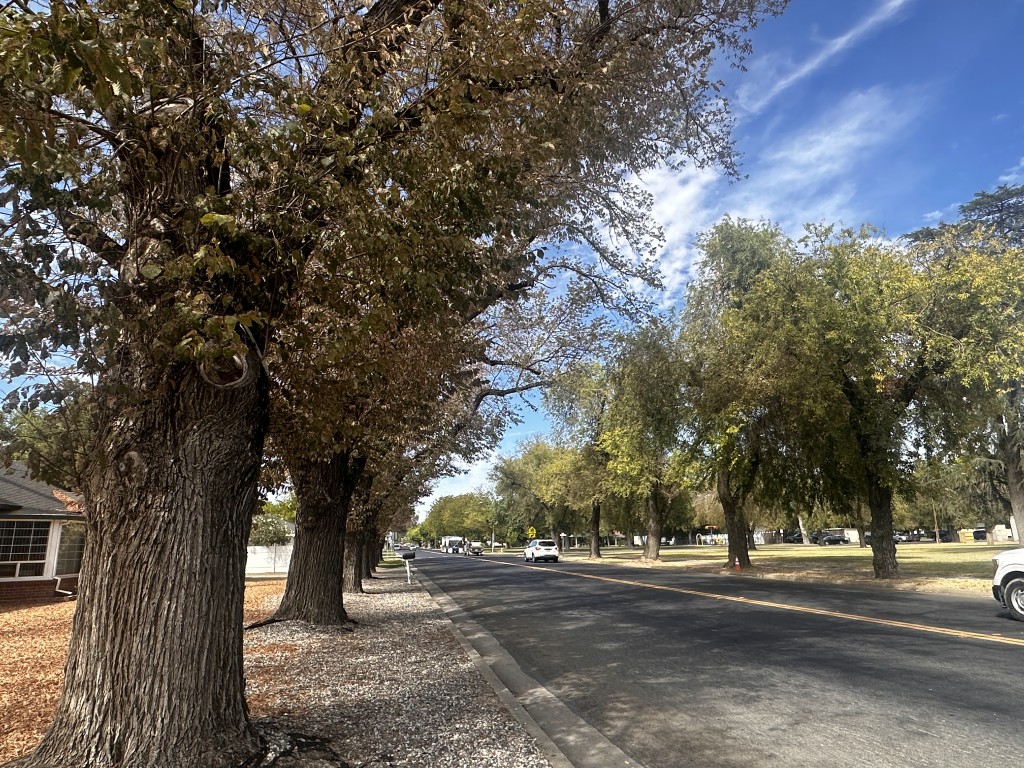
COLUSA, CA (MPG) – A tree-lined stretch of 10th Street that has helped define the entrance into Colusa for generations is expected to look considerably different as Caltrans prepares to remove 43 mature elm trees along 10th and Market streets.
The removal includes 40 American elms along 10th Street and three along Market Street, according to a July 21 arborist report prepared by Caltrans District 3 Vegetation Manager and certified arborist Kris Mitchell.
The trees are estimated to be about 120 years old and are believed to have been planted in the early 1900s.
Colusa City Manager Jesse Cain and Councilmember Greg Ponciano met with Caltrans representatives Aug. 24 after residents and city officials learned the trees were being considered for removal.
Cain said Caltrans told city officials the trees present a significant safety concern and liability to the state and need to be removed as soon as possible.
“Caltrans specifically stated that the removal of these trees has nothing to do with the elm beetle,” Cain said.
Questions about the elm leaf beetle and the city’s treatment of the trees had circulated as residents learned of the planned removal. Records obtained by the Pioneer Review through a California Public Records Act request show the city has contracted with Double A Pest Solutions to treat elm trees for the beetles.
A November 2024 proposal called for systemic injections of approximately 212 elm trees and 220 hackberry trees throughout Colusa for elm leaf beetle and aphid control. The proposal set the treatment cost at 65 cents per inch.
City records include a December 2024 invoice for $7,825.35 for systemic tree injections. A Feb. 10, 2026, invoice shows the city paid another $8,694.40 after Double A reported completing systemic injections on all listed trees, totaling 13,376 inches.
Double A returned May 29, 2026, and performed another treatment on tree trunks and underlying leaves up to 10 feet for elm leaf beetles. The invoice lists the work as a no-cost reservice.
On June 20, 2026, Double A inspected trees along 10th Street and reported finding “evidence of drought stress.” The company said the stress could attract additional pest infestations and recommended another systemic tree injection while the city addressed the drought stress.
About a month later, Mitchell’s Caltrans assessment documented extensive elm leaf beetle activity among the trees, including severe leaf damage and repeated defoliation. However, the report bases its removal recommendation on the trees’ overall condition, including age, structural deterioration, internal decay, dead and declining branches, previous limb failures and damage to sidewalks.
The report states pest-related conditions should be considered alongside the trees’ structural condition rather than as an independent reason for removal.
According to Mitchell’s assessment, the trees range from approximately 36 to 60 inches in diameter and 60 to 110 feet tall.
Caltrans records cited in the report date to 2019 and show approximately 99 emergency callouts associated with the elm trees and 59 routine maintenance work orders. The report also documents a recent incident in which a large cracked limb became suspended in another tree over the roadway, requiring a crew to respond that day.
“The trees have passed their useful life and have issues including limb rot and significant splits within the trees,” Cain said.
The trees’ roots have also caused continuing sidewalk damage, creating uneven surfaces and pedestrian trip hazards. Caltrans has made temporary repairs, but the report concludes those repairs cannot provide a permanent solution while the underlying roots remain.
Mitchell ultimately recommended removing all 43 trees, concluding that pruning and routine maintenance would not correct the underlying structural and root problems.
“The recommendation is based on the cumulative condition of the population rather than any single defect,” Mitchell wrote in the report.
That recommendation has drawn questions from community members and at least one city council member over whether Caltrans evaluated each tree individually before recommending removal of the entire group.
Community members sought an outside review of the Caltrans report from consulting arborist Gordon Mann. Mann is an American Society of Consulting Arborists registered consulting arborist, an International Society of Arboriculture certified arborist and municipal specialist and holds an ISA Tree Risk Assessment Qualification.
Mann questioned whether the Caltrans report provides enough information to support removing all 43 trees. He said the document provides a general assessment of the tree population rather than identifying conditions and risks associated with each tree.
“This report does not inspect each tree or show the issues with each tree,” Mann wrote. “It is a summary report.”
Mann said some trees may require removal but argued that others could potentially remain through pruning or other risk-management measures.
“It doesn’t mean a couple may need removal while others can be pruned to manage the risk of branch failures which appears to be the main concern,” Mann wrote.
Mann also questioned the report’s use of the 99 emergency callouts and 59 maintenance work orders. He said the report does not provide details showing which individual trees were involved in the calls or the nature of each incident. He recommended obtaining the underlying Caltrans maintenance and emergency records before removal proceeds.
Community member Alison Yerxa also questioned removing the trees as a group without individual assessments.
“The city, or the citizens, need to get a verifiable arborist assessment of each tree,” Yerxa wrote in an Aug. 31 email to city officials and community members. “Those that need to be taken down should be, and those that need to be monitored would be. Those that need to be replanted should be.”
Yerxa said the mature trees contribute to the appearance and shade of the corridor and called for the city to develop a plan for maintaining its tree canopy.
“Our trees are the incredible entrance to the town, an immense part of its beauty, a great help to keeping summer temperatures on the sidewalks manageable, and a reason why people want to live in such a town as ours,” Yerxa wrote.
Questions about the removal have also reached the City Council.
In an Aug. 31 email, Ponciano said he had not received additional information concerning assessments of individual trees.
“Maybe Jesse can help us find out any kind of legal angle to put a pause on this or who else to reach out to,” Ponciano wrote.
Ponciano included City Attorney Robert Wakefield in the correspondence seeking advice.
The email chain also shows Caltrans District 3 Public Information Officer Megan Reese told Ponciano on Aug. 27 that she was gathering additional information and details in response to his questions.
Cain previously said Caltrans expected the identified trees to be removed within approximately 40 days.
The removal would significantly change the appearance of the 10th Street corridor, where the mature elms have formed part of the streetscape for more than a century.
The issue comes as the community is also confronting uncertainty over the future of the historic Colusa High School property along 10th Street, adding another potential change to one of the city’s prominent corridors.
What replaces the trees and damaged sidewalks will take longer to determine.
Cain said Caltrans told city officials its Right of Way Landscape Team will spend the next two years developing a plan to replace damaged sidewalks and address landscaping along 10th Street.
The arborist report recommends reconstructing damaged sidewalks and developing a replacement tree program using species suited to the available space, roadway, sidewalks and other infrastructure.
“The City of Colusa will be working with Caltrans to determine what improvements we may be able to accomplish sooner and how we can work together to improve the appearance of the corridor,” Cain said.
Cain acknowledged the effect the removal will have on the appearance of 10th Street but said Caltrans has an obligation to respond once the trees have been identified as safety hazards.
“The City will continue working with Caltrans throughout this process to make sure that, while the trees must be removed for safety reasons, we also work toward restoring and improving the landscaping and appearance of 10th Street,” Cain said.