

ARBUCKLE, CA (MPG) – After months of wastewater spills, rising costs and increased state oversight, the Arbuckle Public Utility District held a special public meeting Jan. 29 to answer questions about system failures, financial strain and what residents can expect next.
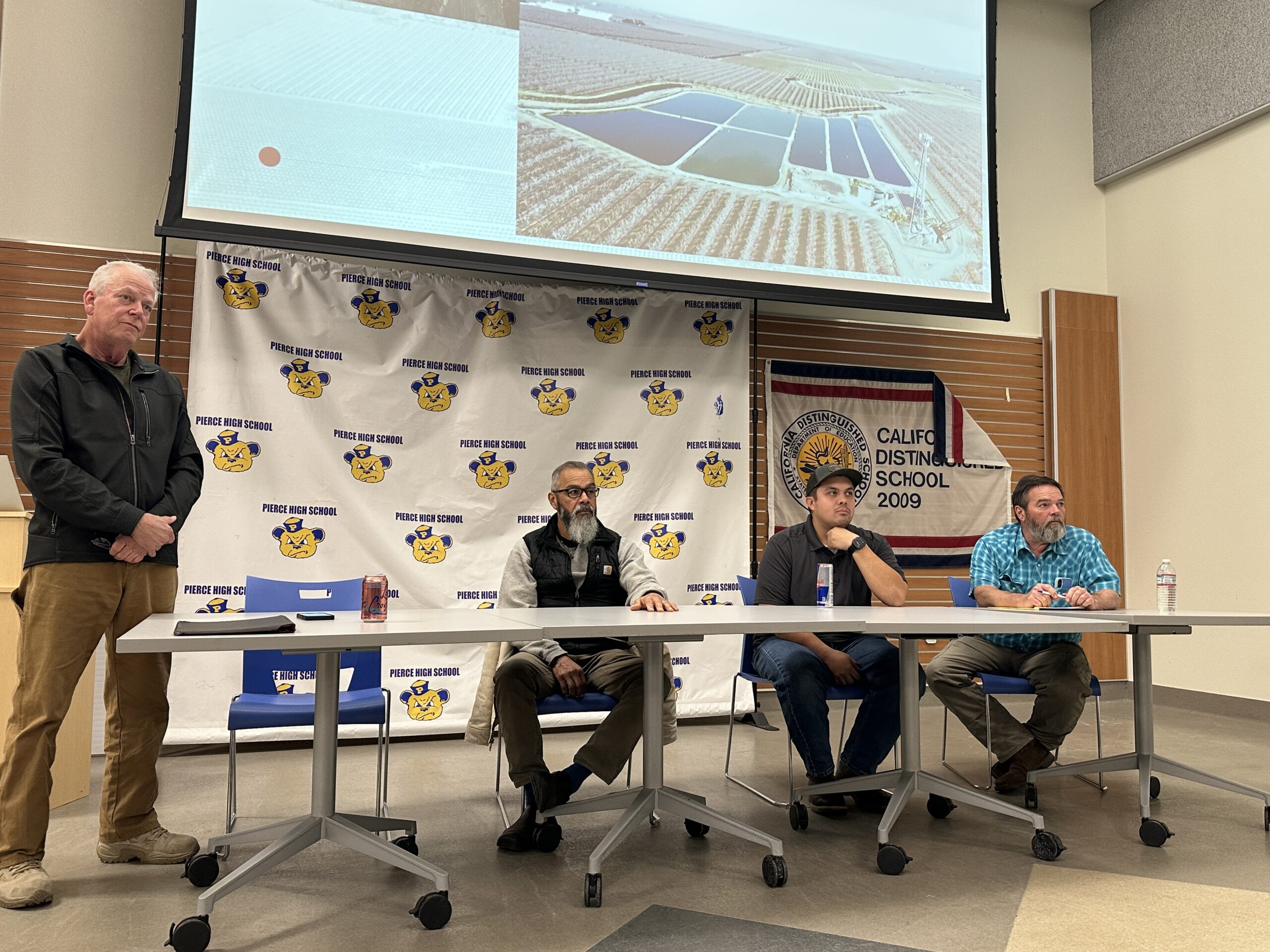
The town hall-style meeting drew about 20 residents, along with Colusa County Supervisors Merced Corona and Kent Boes and Bruce Ross, a representative from Sen. Megan Dahle’s office. Board President Kevin Wood led the presentation, joined by directors Jonathan Ring and Juan Diaz and General Manager Gary Felkins.
Wood said the special meeting was scheduled to allow multiple board members to attend and provide a full public accounting of the district’s situation.
“We wanted to lay out where we are, how we got here and what we’re trying to do to fix it,” said Wood.
According to Wood, the district began recognizing serious capacity problems at its wastewater ponds in late 2021. Much of the system dates back to the 1950s, including original ponds and mechanical components that remain in service.
“At the end of 2021, we identified that we were having issues keeping up with the amount of inflow coming into the ponds,” said Wood.
The district hired engineering consultants to assess the problem and pursue grant funding. Recommended fixes included dredging ponds, adding evaporation measures and making operational changes intended to improve percolation. Wood said those efforts did not prevent future overflows.
The district reported its first recent wastewater spill March 31, 2023. Additional spills followed in 2024 and 2025, including one in June 2025 that flowed into an adjacent orchard. The California State Water Resources Control Board later issued a cleanup and abatement order requiring dredging, levee repairs, updated response plans and a minimum 1-foot freeboard in the ponds.
Wood said the district complied with all reporting requirements.
“We followed every single law and regulation on reporting,” he said.
To prevent further spills, the district began hauling wastewater to other treatment facilities. Initially, water was hauled to Orland, which Wood described as costly due to distance and transport fees. After regulatory approvals and assistance from legislative offices, the district began hauling to the City of Williams, which reduced costs but did not eliminate the financial strain.
“We realized we would rapidly run out of money if we had to do that for a prolonged period of time,” said Wood.
Hauling was paused when pond levels dropped, then resumed as levels rose again. Wood said the district currently has no funding in place to resume hauling if pond levels rise again this spring.
The district is now waiting on a state planning grant intended to fund long-term wastewater solutions. Wood said the timeline has repeatedly shifted.
“We were told January, then February, then later in the year,” said Wood. “That planning grant is critical. Without it, we really can’t move forward.”
The long-term goal, according to Wood, is to replace the existing system with a modern wastewater treatment plant capable of producing tertiary water for reuse. In the shorter term, the district is exploring land acquisition for land application, which would allow treated wastewater to be used for irrigation of certain feed crops.
“That’s what buys us time,” said Wood. “Short term, medium term and then the long-term solution.”
Financial impacts remain a concern for residents.
A Proposition 218 rate study for wastewater is underway and could result in higher sewer rates. Wood said a public hearing will be scheduled once the study is complete.
“That’s when the community needs to come and ask questions,” said Wood. “We don’t want to do this without public input.”
Supervisors Corona and Boes said county officials are aware of the district’s situation but stressed that the county does not oversee the district and cannot directly intervene financially.
“We don’t have oversight authority, but we all serve the same community,” said Boes, adding that he and Corona have worked to connect the district with state and federal agencies and continue to advocate for assistance.
As the meeting concluded, Wood said the board remains focused on transparency, pointing to recent updates to the district’s website and emergency alert system. Several residents raised concerns during the meeting about notification gaps, spill impacts and long-term costs.
With grant funding still pending, rate increases under consideration and the next irrigation season approaching, the district’s path forward remains uncertain.
For information on future meetings or to sign up for Arbuckle Public Utility District alerts, visit arbucklepud.org.