

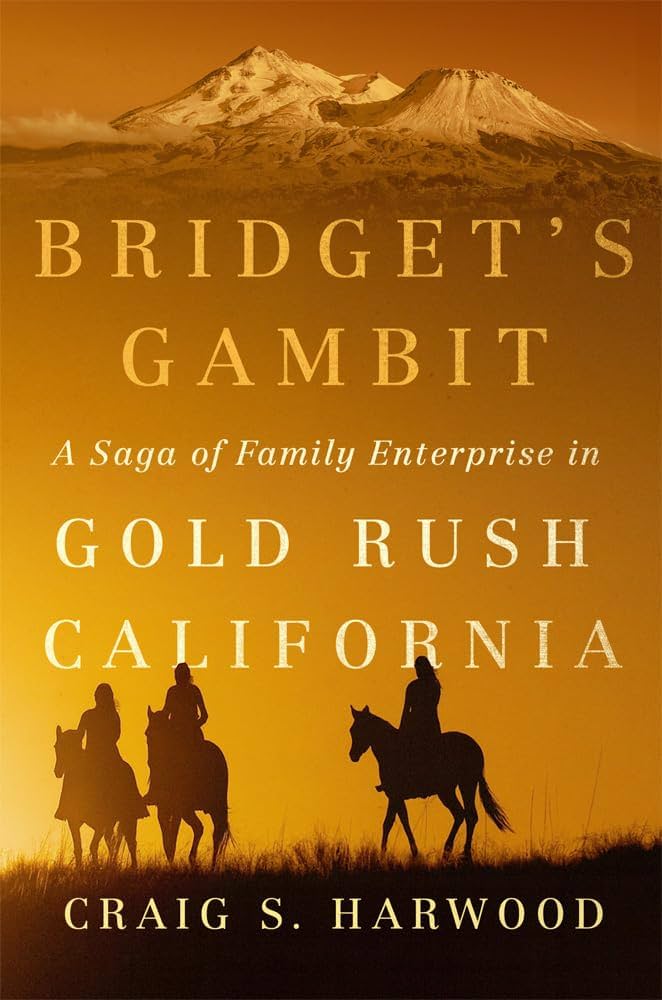
 I grew up surrounded by California history and stories of the Gold Rush. Elementary trips to Sutter’s Fort and gold panning that spring in Woodleaf. Like many, most of what I learned centered on the men who came west seeking gold, those that built businesses and established communities that remain today.
However, Craig S. Harwood’s “Bridget’s Gambit: A Saga of Family Enterprise in Gold Rush California” changed my perception.
Bridget Miranda Evoy left a famine-stricken Ireland seeking a better life in America. Soon, she lost her husband and found herself having to raise five children on her own. She quickly learned to work to earn her keep, but those struggles reminded her of Ireland.
By 1848 the discovery of gold was transforming the west, she and some friends packed up their belongings and took their families west. It was a difficult trip to embark in the winter of 1849 and their trip into California almost ended their story. Their survival in part due to the whispered advice of a Mormon woman in Utah.
What impressed me about Bridget was that she simply did not endure her circumstances. She recognized every opportunity of survival, and how to profit from them.
While she raised five children, she helped lead their group west on the Overland Trail and eventually established herself as a businesswoman. Alongside her daughters Ellen and Margaret, Bridget pursued commercial ventures and property investments, finding ways to capitalize on the growing economy surrounding the Gold Rush.
It would be easy for a story like Bridget’s to rest heavily on family lore. However, according to Harwood, oral history passed down through the family provided part of the foundation for her story. He then looked find proof of the accounts through newspaper articles, census and tax records, journals from others who traveled the same trail and histories of Northern California and Nevada.
His research gives the book substance without overwhelming the story. Harwood also does not ignore the darker parts of westward expansion. When the journey brings settlers into conflict with Indigenous people, he addresses those encounters and the deaths that resulted.
Despite the depth of research, “Bridget’s Gambit” does not feel like a collection of historical records. Harwood keeps Bridget and her family at the center, allowing the larger events unfolding around them to provide context.
One of my favorite episodes comes on Page 99.
While traveling from Briggsville, in Shasta County, to Marysville, Bridget encountered former state Sen. John H. Harper. During a stop at John Bidwell’s Rancho Chico, Harper stole Bridget’s satchel containing $1,800 in gold dust.
Bridget confronted him. Harper was arrested, convicted and sentenced to seven years at San Quentin.
Harwood concludes the episode: “Harper had tangled with a member of society’s ‘weaker sex’ and had come out of it decidedly scathed.”
By this point in the story, I had learned enough about Bridget to know Harper had underestimated the wrong woman.
His sentence was later commuted by Gov. John Bigler on the condition that he leave the state of California. He did, and relocated to Nicaragua where he lived for the remainder of his life. You don’t mess with Bridget Evoy.
Bridget’s connection to Northern California also made the book feel close to home.
I have driven through the historic areas of Marysville and Yuba City countless times. Now I wonder where Bridget and her family lived, which streets they walked and whether buildings connected to their lives remain.
More than anything, “Bridget’s Gambit” left me wondering how many other women were like her.
We know the stories of California’s sons who came west seeking opportunity. What about its daughters?
For anyone curious about the Sacramento Valley, early California or the people whose lives helped shape the state, “Bridget’s Gambit” is worth the read.
It left me wanting to find the other Bridgets whose stories have yet to be told.
“Bridget’s Gambit: A Saga of Family Enterprise in Gold Rush California” is available through Amazon and other booksellers.