

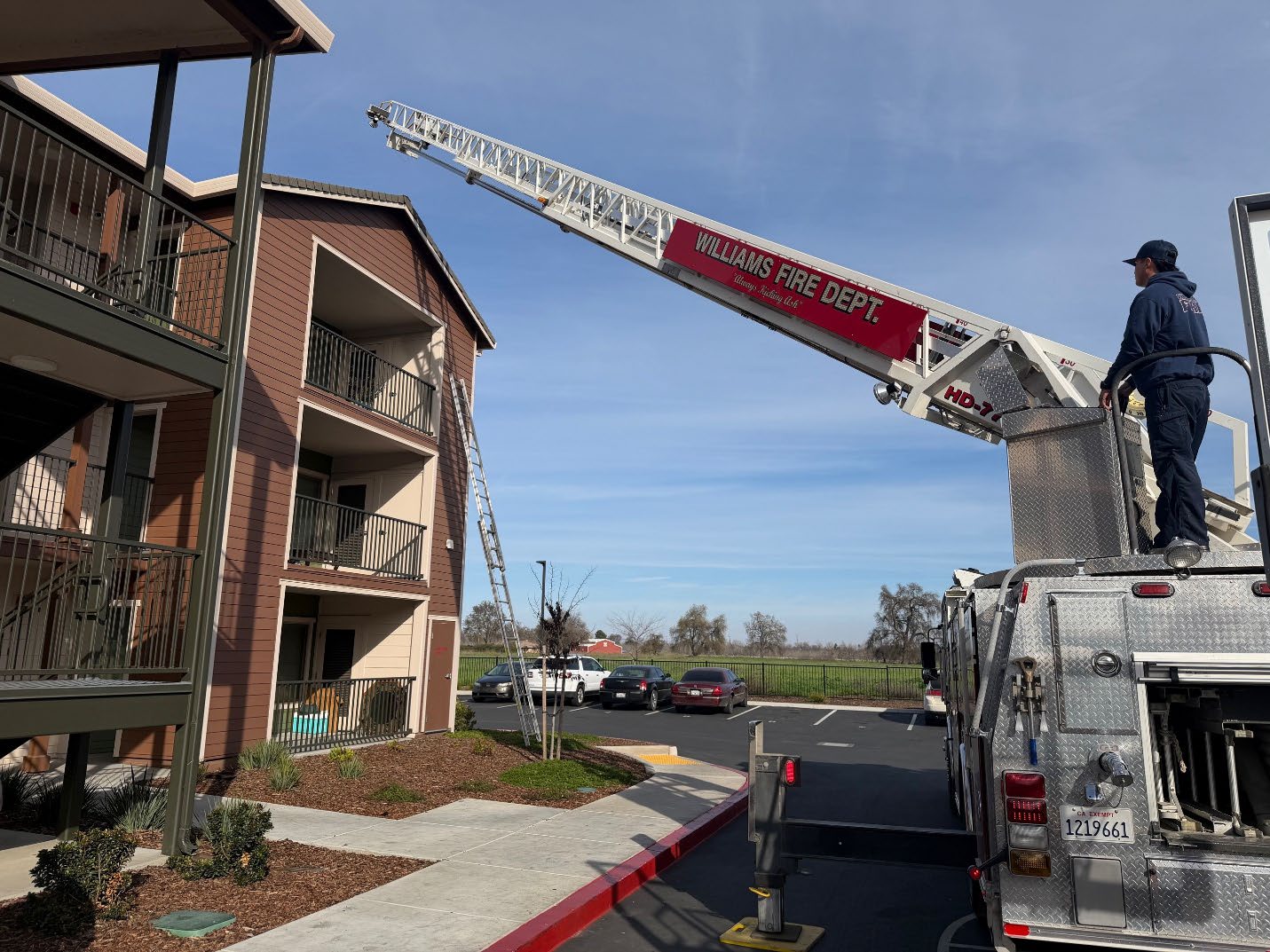
COLUSA, CA (MPG) – The Colusa City Council voted to table a decision on securing a contract for a new aerial ladder fire truck after discussion raised questions about long-term funding, financial risk and timing.
Fire Chief Logan Conley asked the council to approve a source-flow contract with Rosenbauer to hold a ladder truck currently scheduled for manufacture. Conley said prices for fire apparatus continue to rise and delaying action could further increase costs.
“It’s been a long time talking about purchasing a ladder truck,” Conley said. “We’re at a breaking point where we have to make a decision on equipment that always needs to be replaced.”
The Colusa Fire Department is operating frontline fire engines that are up to 24 years old, with its newest engine now 13 years old, according to department officials. National Fire Protection Association standards recommend apparatus exceeding 10 years of service be placed into reserve status and replaced as first-out units. A ladder truck would address aerial and rescue needs while also serving as the department’s primary first-out apparatus for structure fires and rescue calls, improving reliability, firefighter safety and emergency response.
According to Conley, the cost of a similar ladder truck has increased from about $1.05 million in 2023 to approximately $1.495 million today. He said the specific unit previously under consideration had already sold, and the next available unit in the production queue had increased in price by about $50,000 over the past three months.
Conley emphasized that entering the contract would not require immediate payment. Delivery is estimated at roughly two years, and the city would not make a down payment or annual lease payment until the truck arrives.
He outlined a proposed financing plan that included a $500,000 down payment and a 10-year lease with annual payments of about $145,000. Funding would likely come from a combination of fire strike team revenue and impact fees, subject to council approval.
Conley said the ladder truck would replace the department’s first-out Type 1 engine while also providing expanded capabilities. The proposed truck includes a 1,500-gallon-per-minute pump and could serve as both a ladder and structure engine.
“It makes more sense, budgetarily, to go with one more capable unit rather than buying a Type 1 now and realizing a few years later we should have bought a ladder truck,” Conley said.
Several council members said they were not opposed to the need for the truck but wanted clearer financial data before committing to a contract.
“I would have liked to have seen at least 10 years of numbers,” Council member Daniel Vaca said. “We’re talking about a 10-year obligation, and we need to understand what that looks like year in and year out.”
Conley acknowledged the concern and said detailed strike team revenue and expenditure data were still being compiled as city finance staff transition to new accounting software. He shared preliminary figures showing strike team revenue ranging from about $91,000 in a low year to more than $512,000 in a high year, noting that some years included one-time equipment purchases and unusual expenditures.
Council members raised concerns about relying on strike team revenue, which can fluctuate based on fire seasons and deployment activity. One member pointed to a recent year with lower revenue and questioned whether the city would need to rely on the general fund in that scenario.
“If we have a bad year and still have to make that payment, where does that money come from?” Vaca asked.
Conley said he remained confident the payments could be covered through strike team revenue based on historical trends. He also noted that the fire department has not used general fund money to purchase major fire apparatus in more than 20 years.
“If our department hadn’t participated in strike teams over the last two decades, the general fund would have absorbed millions in equipment costs,” Conley said.
Council member Greg Ponciano said the city has repeatedly relied on strike team funds to stabilize the general fund during tight budget years and argued the time has come to reinvest those revenues back into fire equipment.
“When the city has been in a pinch, we have routinely moved strike team money over to balance our budgets,” Ponciano said. “We borrow from those funds all the time. At some point, it makes sense to put that money back into the fire department and invest in long-term equipment.”
Conley noted that future funding options could include strike team funds, grants, financing or other revenue sources. Some council members said that language added to their unease.
“I’d rather see this come back with a clearer picture of how it’s going to be funded,” Mayor Denise Conrado said.
During public comment, Colusa resident Janice Bell urged the council to prioritize life safety and warned that aging equipment and taller buildings increase risk.
“You don’t have the capability to respond to some of these structures,” Bell said. “This is about life safety.”
Bell also cited the city’s ISO rating, saying aging equipment could affect fire insurance costs for residents.
After discussion, the council voted to table the item to a date certain of March 3. The delay allows staff time to provide more detailed financial records and gives the council time to review them before the manufacturer’s price quote expires later in March.
Conley said his goal was not to back out of the contract but to secure the city’s place in the production queue while financial questions are resolved. He noted that early cancellation penalties would be limited if the city chose not to proceed.
Council members requested clearer financials, including detailed ledgers showing strike team income, expenditures and past equipment purchases.
“I just want to make sure we’re not scraping the barrel every year,” Council member Ryan Codorniz said.
The matter is expected to return to the council agenda next month.