

YUBA CITY, CA (MPG) — Long before the crowd arrives, sevadars pack petals and adorn the float with florals, fabric and ornate decorations. Months in the making, it is ready.
By Sunday morning, it waits for hymns and a light rain of petals to lead the Guru Granth Sahib into the streets.

The celebration, Yuba City’s annual Nagar Kirtan, a religious procession that carries Sikh scripture and song into public view.
Inside the Gurdwara Sahib temple, readers recite continuously from the Guru Granth Sahib, regarded as a living teacher. While a chauri, a whisk made from animal hair, moves softly above the pages.
The hymns of religious teachings, historical narrative, or political messages guide the Guru Granth Sahib procession as it leaves Tierra Buena Road and makes its way through the city.
The Nagar Kirtan invites Sikhs to practice seva, or selfless service, through the gift of time and skill. A sevadar is a person who serves without seeking credit. Many sevadars prefer not to be named; where individuals agreed to be identified, their names are used with permission in that same spirit of service.
Behind the work is a simple teaching. “God is one,” a sevadar said, offering a doorway into Sikh belief.
She described the Golden Temple in Amritsar, Punjab, India, as having four doors, open on all sides to welcome anyone, and how visitors step down to enter as a sign of humility. Equality and humility are not abstractions here. They shape how people gather, serve and eat throughout the weekend.
She also explained that the five K’s serve as constant reminders of duty: kesh, uncut hair; kanga, a wooden comb for cleanliness and discipline; kara, a steel bracelet for unity and restraint; kachera, modesty and readiness; and kirpan, a commitment to protect others. In prayer and community life, Sikhs pair devotion with action for the common good.
Sevadars plan shifts and step in where needed: construction, cooking, serving, cleaning, or prayer. The children learn by doing, working alongside elders on simple chores. The lesson is practical: do the job well, then move to the next task.
While the float functions as a moving altar, it’s an ongoing project. Last year’s fabric and ornaments are removed, new panels are measured and fitted, and colors matched to the temple’s altar. Fresh flowers arrive late in the evening, and garlands come at dawn for the clergy. As a volunteer keeps watch, another checks a list for a final supply run.
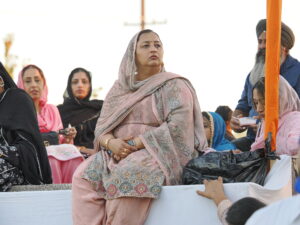
At 10 AM on Sunday, a helicopter filled with rose petals circles the Guru Granth Sahib, blessing onto the route ahead of the float, and the city hears the first notes of the day.
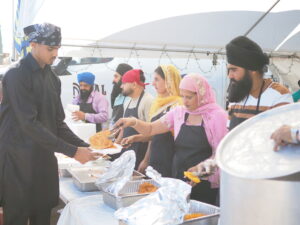
Food anchors the gathering with langar, the community meal open to everyone.
Families and groups bring ingredients, time and skill. The kitchen runs in steady rotation as warm and earthly spices fill the air as roti, an unleavened flatbread, is stacked; and pots of daal, a simple lentil soup; sabzi, a cauliflower and seasonal vegetable dish; and rice is ready for a feast.
The lines form, and people sit and eat as equals.
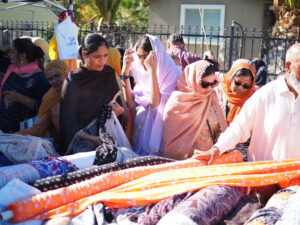
Along the parade route, stations hand out hot meals, snacks and water at no cost. The principle is direct: share what you have.
From the curb, the day can look like a parade, but for Sikhs it is an act of faith shaped by weeks of planning.
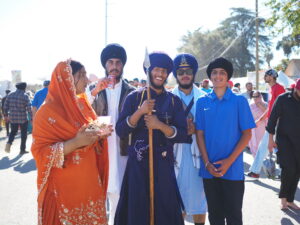
Organizers expected more than 200,000 people this year. The event costs millions, much of it covered by in-kind and monetary gifts from Sikh community members.
The festival also boosts the local economy as visitors fill hotels, eat at restaurants, and shop at small businesses throughout Yuba-Sutter.
For Jill Lessard, owner of Elegante Petals in Yuba City, organizers entrusted her with many of the floral arrangements and offered this reporter a behind-the-scenes look at Yuba City’s Nagar Kirtan.
“For the past several years I have made the arrangements for the altar in the temple and on the float,” Lessard said. “I also provide the wreaths for the granthi and the petals for the helicopter.”
Lessard said she spends hours the night before the procession preparing bags of rose petals that will fall ahead of the float carrying the Guru Granth Sahib.
As soon as crowds thin, cleanup begins. Crews sweep sidewalks and empty cans. By Monday, streets look like they did the week before. The float returns to its bay.
Why it matters often escapes notice.
“It’s a journey to celebrate peace and equality,” said Tejinder Dosanjh, the Gurdwara’s secretary. He described Nagar Kirtan as hymns carried through the city, not a spectacle for its own sake.
“We invite everyone. People eat together and serve together,” he said.
Each first weekend of November, crowds line the route. Sevadars spend weeks on seva to prepare Yuba City’s Nagar Kirtan, held in honor of the Guru Granth Sahib, to bring more peace to the streets. Hymns carry through town, and langar feeds the community in a spirit of service.