

COLUSA, CA (MPG) —The Colusa Masonic Lodge celebrated its 150th anniversary this year, marking a milestone for one of the county’s oldest institutions and a gathering place that has shaped the community for generations.
Founded under charter in 1860, the lodge has been a steady presence through war, famine, drought, and depression, according to longtime member Brent Arnold.
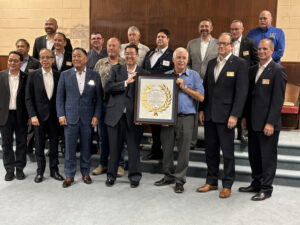
anniversary celebration, where a commemorative plaque was presented to mark the milestone. Courtesy photo
“We survived many wars, we survived famine,” Arnold said. “We’ve survived both droughts and depression locally and nationally. And we’ve always been a place where men can get together, support our families, and show the best the community has to offer.”
The lodge was first placed under dispensation in 1859 and chartered by the Grand Lodge of California the following year. Twenty-nine men, including Arnold’s great-great-grandfather, John T. Arnold, petitioned for its creation. Early records show the challenges of forming a lodge in a frontier community where drought and famine slowed progress.
Yet when the timing was right, Colusa Masons formalized their role.
During the Civil War, the lodge brought together members who held differing views, including Northern and Southern supporters. Arnold noted that while disagreements existed, the lodge maintained a tradition of discourse.
“That’s something we’re kind of missing these days,” he said. “When anyone can disagree, but get together and have a conversation, that’s how we move things forward productively. That’s how you come to a solution.”
The history of Colusa Masonry included division and reconciliation.
In 1865, some members formed Equality Lodge, not because of the Civil War, but because of differences over lifetime memberships. The lodges consolidated again by 1872.
The fraternity endured hardships, including two devastating fires. The first lodge met upstairs in a blacksmith’s shop at Sixth and Main streets, a site documented in county records. Later, the Masons built their own hall before it, too, burned. They shared space with the Odd Fellows before completing their current block building in 1950.
“The second building was absolutely gorgeous,” Arnold said. “We have some wonderful pictures of it until it burned up. You’ll notice this building is made out of cement block. Not a lot of wood.”
Over time, lodges across Colusa County consolidated into Colusa, leaving its hall as the central gathering place. At one point, six lodges operated in Colusa County.
Beyond their own hall, Masons left a mark on the community’s civic landscape. Many public buildings bear cornerstones laid by Freemasons, a tradition carried out not as advertising but as a reminder of cooperative work.
“If you walk around to any major building in this town or this county for that matter, and you look in most cases on the northwest corner, you’ll see that Freemasons left their mark,” Arnold said. “Not for advertisement, not for the betterment of themselves, but to show that people can work together to build a better tomorrow.”
As the lodge celebrates 150 years, members face new challenges. Like many rural lodges, Colusa’s membership has declined as younger men move away. Arnold recalled leaving town himself to serve in the Navy and said attracting new members is key to the lodge’s survival.
“One of our challenges now as we move forward, beyond all of the wonderful history that we’ve celebrated, is to encourage young men to come in and have the conversations and the ability to discuss the future that we’ve all been afforded,” he said.
The anniversary was marked with a plaque presentation, and several visiting dignitaries from around the state. From its beginnings in 1859 to today, the Colusa Masonic Lodge has withstood fire, war, and shifting generations. It has been a place where discourse across divides was possible and where community members helped lay the foundations of civic life. For Arnold, the history is not only about the past but also about preserving the tradition for the next generation.
“It’s important not only to understand our legacy, but to help spread the word of our legacy,” he said.