

MAXWELL, CA (MPG) – Few people at last week’s Maxwell Community Plan meeting oppose the construction of the Sites Reservoir, but its impact on the small community in western Colusa County has created anxiety about whether Maxwell can put infrastructure into place to accommodate the needs of workers and eventual tourists.
“There is not even a public place to take a break or use a restroom in Maxwell,” said Tish Nerli, a member of the Maxwell Park and Recreation Board of Directors. “There’s only a port-a-potty at the Chevron Station.”
The meeting on July 24 at the Maxwell American Legion Hall was the second in a series of planned meetings, hosted by the County of Colusa, to craft a Community Plan to guide land use, zoning, and regulations in the area of the reservoir, as well as economic policies and actions the Board of Supervisors can adopt that will lessen the negative impacts of the reservoir and construction, while maximizing its benefits, including increased tourism.
Construction on the reservoir is expected to begin in about two years, with Maxwell’s biggest concern being that of traffic, public safety, and housing accommodations for temporary and permanent workers.
Based on Site Project Authority estimates, the construction period will begin in 2026 and take about six years, said consultant Ben Ritchie, of DeNovo Planning Group, who coordinated the meeting with Maxwell residents to develop the plan.
“By 2032, they expect the construction to be done and the reservoir to be in place,” Ritchie said.
While the reservoir may take years to fill with water, depending on the amount of rain, recreation is expected in the form of a couple of campgrounds and a boat launch.
“Other than that, there is very little development or lake access proposed as part of the Sites Project,” Ritchie said.
Ritchie had meeting attendees break into work groups to list short- and long-term opportunities that could come from the construction of the reservoir, as well as short- and long-term challenges.
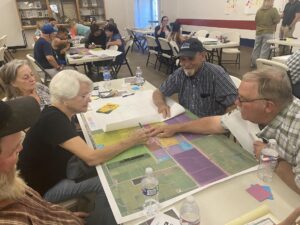
While people seemed excited that existing and new businesses would prosper, most felt the impacts on roads, water and sewer infrastructure, police and fire services, along with the lack of housing would be more difficult to overcome without leading to increased costs to residents.
“If there are grants to pay for everything then that would be great,” said a resident at the meeting. “But who is going to pay for it, if not?”
Randy Johnson said there were still too many unknowns for him to see significant investments being made by property owners to accommodate construction workers, and what most fear will result in an “Olympic Village” or ghost town effect once the reservoir is completed.
“I need more information; I would like to know when the Folsom Dam and Oroville Dam were built, where did the people stay, did they bring families, and did they stay afterwards,” Johnson said.
Johnson said it may be smarter for Maxwell to be cleaned up, a few businesses added, and houses built on empty lots rather than constructing large residential neighborhoods. He also thought Maxwell would need to upgrade water and sewer, address drainage and flooding, and accommodate only sustainable growth.
“We do need a grocery store, but will it be supported after the dam is built?” Johnson asked. “We want all this stuff, which the property owners will have to pay for, but are these people going to just pack up and leave so we look like the outskirts of Oroville with a lot of empty houses? We do not want to ruin the town of Maxwell. We want it to keep its charm and maintain the family life.”
Residents said they also have great concern if people stay, what impact it would have on Maxwell schools, which already needs major construction and upgrades. People were also worried about an increase in crime before, during, and after construction of the reservoir.
Ritchie said by the next meeting, he will have compiled the outtakes of the meeting and have those documents available to the public. Colusa County also plans to develop a website dedicated to the Maxwell Community Plan.
Colusa County officials and DeNovo will conduct similar meetings in the Stonyford area to develop a Community Plan for the foothill area.