

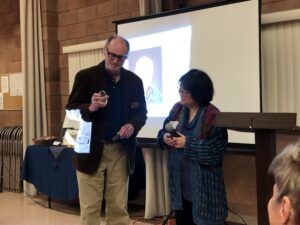
COLUSA, CA (MPG) – Growing up in the 1950s in Colusa, Lani Yoshimura was mostly shielded from the harsh truth of where the Japanese people that once lived along the Sacramento River had gone.
In the early 20th century, about 500 people of Japanese ancestry worked in agriculture, in homes, or owned businesses, and peacefully coexisted on Main Street with the Chinese, who came to Colusa about a generation earlier.
While families came and went throughout the 1920s and 1930s, the Japanese community would endure until World War II.
Following the attack on Pearl Harbor by the Empire of Japan on Dec. 7, 1941, President Franklin D. Roosevelt, on Feb. 19, 1942, signed Executive Order 9066, authorizing the removal of all persons deemed a national security threat, which included those of Japanese ancestry living on the west coast.
At the war’s end, only 25 percent of those families returned, said Yoshimura, who was the guest presenter at the annual meeting on Saturday of the Colusi County Historical Society.
Those who did return integrated into the community and vowed to protect their children from carrying the burden of what had happened to them.
“For a long time, those of us who were their children, we would hear stories,” said Yoshimura, whose parents were born and raised in Colusa. “They were always talking about camp. They would talk about baseball; they would talk about dances; they would talk about going to the cafeteria and the latrines and all that stuff. We always thought it was summer camp. It wasn’t until high school that I finally caught on to what it really was. Nobody wanted to call it what it really was.”
Yoshimura’s maternal grandfather, Frank Hinoki, had immigrated to Colusa around 1914, working first as a houseboy until he came to co-own Tozai Laundry, and eventually owned and operated Hinoki Cleaning Works.
Following Roosevelt’s order, Yoshimura’s family, which included her maternal and paternal grandparents, parents (not yet married), and their siblings, along with all of Colusa’s Japanese, were forced from their homes were transported under armed guard to concentration camps in Colorado.
Two-thirds of all the Japanese incarcerated, including Yoshimura’s parents, were American-born citizens, who were imprisoned out of fear and prejudice. Her grandfather, a well-respected community leader, has been falsely accused of signaling Japanese submarines imagined to be in the Sacramento River and was incarcerated in North Dakota.
“Nobody knew where he was for nine months,” Yoshimura said.
Yoshimura said her grandfather would eventually join his family at the Amache Relocation Center in Colorado, but he was never the same as he was before.
Her father, Akiji (Aki) Yoshimura, was recruited from the camp in late 1942 by U.S. Military Intelligence Service, and proudly served his country in the U.S. Army as one of Merrill’s Marauders (named after Frank Merrill), a special operations jungle warfare unit that fought in the China-Burma-India Theater. The unit became famous for its long-range penetration operations behind Japanese lines, often engaging Japanese forces superior in number.
“They trekked through 800 miles of really dense jungle,” Yoshimura said. “Not only did they trek through dense jungle, they actually had to go out of India over the Himalayas and into Burma, into a jungle filled with horrible things, and then climb the Kuban mountains into China.”
Yoshimura said many of Colusa’s Japanese lost everything. Her grandfather was more fortunate.
Rex Bagley, who operated Hinoki Cleaners in the owner’s absence, immediately handed the keys and the business back to Yoshimura’s family.
Aki married Yoshimura’s mother, Hizeko Hinoki in 1946. Together, they operated Vogue Cleaners, until they retired in 1987. Aki died a week later during a trip to the Smithsonian Museum. “Hizi,” as she was known, died in 2023 at the age of 102. She had been an active volunteer in the community, the Colusa County Library, and Colusa Trinity United Methodist Church, of which her family were lifelong members, beginning with her grandfather, who was already Christian when he left Japan.
Yoshimura, who graduated from Colusa High School in 1964, recently retired as director of the Gilroy Library.
She spoke to about 75 members of the Colusa County Historical Society, whose annual luncheon was held at Trinity Methodist Church, the very church Yoshimura grew up in.
The Colusi County Historical Society is a nonprofit organization that was founded 75 years ago to preserve the history of one of California’s 27 original counties formed in 1850.
Colusi, sometimes referred to as Coluse, was in what is now the counties of Colusa, Glenn, and southern part of Tehama.
Charles Yerxa, of Colusa, is president. Longtime Director Gene Russell, of Orland, continues as the editor of the Society’s bi-annual publication “Wagon Wheels.”
In 1969, “Wagon Wheels, Volume II” published “A Brief History of the Japanese in Colusa County,” written by Yoshimuro’s father.
For more information, to read an issue of “Wagon Wheels,” or to become a member, visit the Historical Society’s website at colusi.com.