

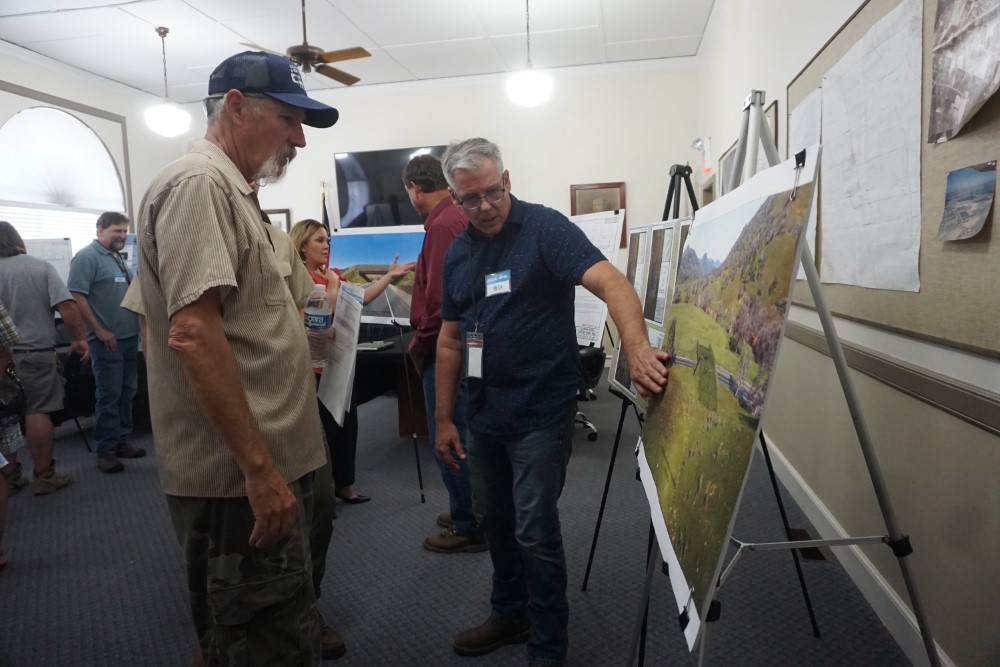
Caltrans and California Fish and Wildlife officials hosted a well-attended open house last Thursday in Williams to familiarize the public with the planned wildlife overcrossing project to reintroduce Cache Creek-Cortina Ridge Tule Elk herds that have been separated by a paved highway for more than 60 years.
The $9 million project is funded with a $8.6 million grant awarded to the Wildlife Conservation Board from Proposition 68, the California Drought, Water, Parks, Climate, Coastal Protection, and Outdoor Access for All Act, which was approved by voters in 2018.
While not a transportation project, Caltrans is seeking comments on the 100 ft. wide wildlife overcrossing, which is proposed to be built over State Highway 20, about 10.5 miles west of Williams, said Michael Ferrini, Caltrnas environmental project coordinator.
State officials said the development of Highway 20 in 1954 divided the Tule Elk in the Bear Valley range. The fragmentation and habitat loss, after Highway 20 was paved, isolated the herds and limited the gene pool to where slight deformities from inbreeding are starting to appear, said CFW biologist Joshua Bush.
Bush said extensive genetic testing of the separated herds in the inland valley indicate they are distinctly different, and hunters have been reporting antler irregularities or deformities (melted antlers) for some time.
The project proposes to provide a way to expand habitat access for elk and other wildlife that will likely use the bridge to cross over the highway.
While Tule Elk are a smaller subspecies of elk found in the Pacific Northwest, selecting the 100 ft. minimum width for the overpass was based on data from similar projects.
“We don’t know what they (Tule Elk) will utilize or what they won’t, so we referenced other crossings,” Bush said. “It’s not a big data set, but the recommendation was a minimum of 100 feet.”
Wildlife bridges, often called “green bridges,” are usually covered in native vegetation to make them appear like a natural part of the landscape and help invite animal passage. The crossings will work in conjunction with a small amount of highway fencing, placed strategically on one or both sides of the overpass, officials said.
“We may have to entice them with salt licks,” said Greg Saiyo, project biologist. “But they will use it.”
The wildlife overcrossing should increase Tule Elk sub-herds access to over 100,000 acres (170 square miles) of inland coastal habitat and connectivity to the greater Bear Valley and Antelope Valley range, which could strengthen the herd for the future, where climate change, drought, and potential wildfire could threaten their long-term survivability, Ferrini said.
Not everyone at the open house supported the project, largely due to the expense at a time where greater need exists elsewhere.
“I think it’s a big waste of money,” said David Kalfsbeek, of the Colusa County Fish and Game Advisory Commission, who was the lone vote on the commission against supporting the project.
Kalfsbeek said he was disappointed Caltrans only notified the local commission a week earlier and that the commission had little time or information to decide their level of support.
“The commission decided if the money wasn’t spent on this project it would just be spent on some other project somewhere else,” Kalfsbeek said. “I don’t think that is a good enough reason to support a project.”
The preliminary environmental study and Proposed Negative Declaration is available for review at Caltrans District 3 office, 703 B St, Marysville; Colusa County Administration office, 547 Market St., Colusa; Williams City Hall, 810 E St., Williams, and online at the Caltrans District 3 website.
The public is asked to submit comments or questions about the project by postal mail or email to Michael Ferrini at Michael.ferrini@dot.ca.gov by 5 PM, Sept. 9. ■