

WILLIAMS, CA (MPG) – As the trend of sustainable living continues to gain momentum, Williams residents have asked the city to overturn its existing ban on backyard chickens.
The Williams City Council on April 15 said it will consider amending its animal ordinance in May to allow up to four hens (no roosters) within the city limits.
“As most people know, you currently cannot have chickens within city limits,” City Administrator Frank Kennedy said. “The City Council has asked us to review the ordinance and make changes.”

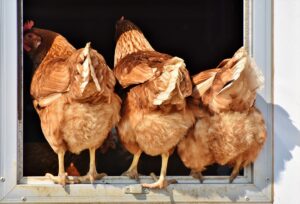
feral chicken population, residents are allowed to keep up to 12 hens (no roosters) for home
enjoyment, egg production or consumption. Image by Alexa from Pixabay
Many California cities allow people to keep hens. In Sutter County, infamous for its feral chicken population, residents are allowed to keep up to 12 hens (no roosters) for home enjoyment, egg production or consumption.
According to the Associated Press, the popularity of small home chicken farms gained momentum during the coronavirus pandemic, only to fall out of favor after the crisis due to the prohibitive cost of chicken feed and the dedication required to maintain safe and sanitary conditions for the birds.
Cities that allow backyard chicken coops typically require hens to remain caged and the area under roosts cleaned daily, with manure stored in “flytight” containers and disposed of weekly.
Kenedy will place an updated ordinance before the City Council but remains skeptical that people will adhere to law.
“Four chickens might mean something else to some people,” Kennedy said. “In somebody’s eyes, that might mean eight chickens, but they will have to remain in a sanitary enclosure.”
Police Chief Chris Miller said he does not oppose the keeping of a small number of hens, whether four or six, and for some people, “it makes sense.”
“But just know that if we get into this – and we do allow it – we already have a lot of time and staff on complaints of chickens,” Miller said.
Miller said if the city legalizes the keeping of backyard poultry, the police department’s compliance enforcement will be extremely difficult because officers cannot enter backyards without a search warrant, making it difficult to determine the exact number of chickens a household keeps.
“As it currently stands, all we can do is pull up and go, ‘I can hear chickens in that yard,’” Miller said.
Kennedy said because city lot sizes are small, a change to the city’s animal ordinance allowing backyard poultry will eliminate the city’s existing 300-foot separation rule, although he strongly encouraged the city to retain a strict regulation that all fowl be kept in a “sanitary enclosure,” currently outlined in the ordinance, noting that resources could not be expended to round up chickens who roam the street as they forage for food.
which gives them a better understanding of where food comes
from. Image by Ralph from Pixabay
“We don’t have the time or energy to turn into chicken police,” Kennedy said. “That might be a problem in the future, and we can try to control them as much as we can. We do not think animal control would be a good resource because their prescribed way to eliminate animals might be cost prohibitive for them to come out for chickens. Maybe some good citizens will capture those chickens and keep them for their own.”
Kennedy strongly encouraged the council to keep the ban on roosters, which is currently a nuisance within the community, created by residents who are keeping poultry illegally.
According to the University of California Agriculture and Natural Resources, there are both benefits and drawbacks to having backyard chickens.
Research indicates that backyard hens produce eggs that are fresher and more nutritious than store-bought varieties, obtaining higher levels of omega-3 fatty acids and vitamins due to the hens’ diverse diets, which often include kitchen scraps.
People also find raising chickens and gathering eggs satisfying and gives them a better understanding of where food comes from.
“I’m flexible around this,” said Councilman Alfred Sellers Jr. “I respect people who raise chickens…as long as people can control what they have. If we say four chickens, no roosters, then they need to adhere to the ordinance.”
Drawbacks include the time and cost associated with keeping backyard hens.
Chickens are also vulnerable to predictors and carry diseases that are transferable to humans.
Since 2022, the USDA has ordered the killing of 100 million birds because of the HPAI (highly pathogenic avian influenza) outbreak, which decimated egg-laying flocks and reduced egg production.
In November and December alone, the virus killed about 17.2 million egg-laying hens, The USDA reported, causing egg prices to increase 40%, compared to about 2.2% for food prices.
A new ordinance will come before the Williams City Council on May 23.
Williams Mayor Maria Belmontes-Leyva said she has spoken with people in the community dealing with stray/nuisance chickens at their residences, as well as people in favor or neutral on the issue.
The Council voted 4-0, with Councilwoman Kate Dunlap abstaining, to consider an ordinance that restricts backyard hens to four, with a requirement that male chickens, once gender can be determined at around six weeks, be disposed of.
Belmontes-Leyva encouraged citizens looking to raise chickens to purchase chicks, chicken coops, bedding, and feed locally.