

COLUSA, CA (MPG) – After making his formal introduction to the Colusa County Board of Supervisors in March, California Senator Brian Dahle returned to Colusa last week to meet with people previously represented by 4th District Senator Jim Nielsen.
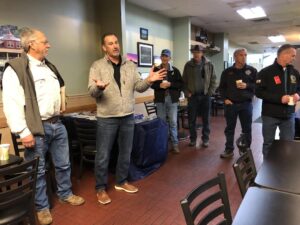
Dahle represents the First District, which acquired Colusa, Glenn, Butte, and Tehama counties by deferral after Nielsen retired in 2022.
About 15 people attended the informal gathering at Market Street Grill on Nov. 3.
Dahle, who was the Republican nominee for governor in the 2022 general election, losing to incumbent governor Gavin Newsom by only 9 percentage points, will represent Colusa County until the end of 2024 when he terms out of office.
The Colusa “meet and greet” visit with Dahle was the last of several events Dahle spent in his acquired counties, touring facilities and speaking with his constituents.
Dahle said the District Days provided him the opportunity to answer questions about Legislative matters.
Dahle brought with him a contingency of staff, who serve in his branch offices, answer phones, and keep an active social media presence.
“We are here to help,” Dahle said. “If we can’t help, we will try to get you to someone who can help. Our goal is to serve you, but I’m pretty upfront; Sometimes we can’t help you.”
While Dahle serves as vice chair of the Energy Committee, vice chair of the Committee on Environmental Quality, and serves on the Transportation, Government Finance, and Natural Resources committees, as well as Budget Subcommittee 2, the Republican senator acknowledged that California is a one-party state controlled by mostly urban Democrats, whose priorities are not rural issues.
“I am one Senator who represents 15 counties,” Dahle said. “Los Angeles County has 15 senators; they are all Democrats.”
Colusa County Supervisors Daurice Smith, Merced Corona, and Chairman Kent Boes attended the gathering, as did Colusa Councilwoman Denise Conrado, and a few county department heads.
Both Corona and Smith voiced their concern over the State of California abandoning its obligation to fund the Williamson Act, a state program created to protect open space and agriculture from development by backfilling the county’s losses on property taxes.
In Colusa County, that loss amounts to about $800,000 a year, which Smith said is badly needed to support local services. Colusa County has been covering the property tax loss since the state drastically slashed its subsidy payments more than a decade ago.
When Corona asked where Dahle sees the program heading in the future, Dahle’s answer was less than hopeful.
“We worked on it, but it never got through the appropriation process,” Dahle said. “We couldn’t get it done when we had a $108 billion surplus; I don’t think we can get it done when we have a deficit.”
Dahle said when California had a surplus, both Republican and Democrat legislators in the valley that represent agriculture put together a bipartisan request for the Legislature to fund the program, which, at its peak, was only $38 million.
He said it is not likely the state will ever fully fund the program again.
California estimates a $25 billion budget deficit this year, Dahle said, largely because highly taxed and over- regulated businesses are leaving the state.
Dahle said about 360 national businesses recently left California for a better business climate, including Tesla, Hewlett Packard, and Oracle, which all moved their global headquarters to Texas.
“And all their people who were top paid left too…If they are able to move, they move. Just last week there were 221 jobs that left Woodland for Mexico. That’s 221 jobs in Woodland that are now gone, but the Legislature doesn’t seem to care.”
Dahle said he has argued in the Senate that when there is a strong private sector, there is a lot of money coming in – and when there is a weak private sector, there is less.
But the problem, he said, is most Democratic legislators are not business owners and their priorities are funded by power brokers, such as the unions and trades.
“Until we see a change in people who serve because they want to do the right thing – not because it’s the best job they’ve ever had and they want to keep their power – we are going to continue to see the power brokers run the situation. Nothing is new in politics. The ones who show up take from the ones who don’t.”
Dahle, a farmer, said there is basically no one in Sacramento that represents small businesses or the common, everyday person. Instead, they represent lobbyists for large businesses, whose job is to make sure there are not any little businesses, and lobbyists for large government agencies, who continually want more from the government to
grow their bureaucracies.
Conrado, a Democrat, said she believes the problems in California have to do with highly polarized political parties that won’t work together or compromise.
“That’s how I am going to vote…when I see people coming together to do what is best for our society,” Conrado said.
Dahle didn’t disagree with Conrado’s philosophy, but the compromise isn’t a matter between Democrats and the Republicans, because the Republican party in California holds no power at all.
“If you don’t like what you are getting in California, you can't blame a Republican,” Dahle said. “We have zero control. That is a fact. We’ve put forth bills. If it’s a great bill; they will take it and kill it and then give it to a Democrat to run the bill. When I say they, there are a lot of great Democrats that I work with. I work across the aisle because I have to. I can’t get a piece of legislation done without their help. They’re in control.”
The problem in California, Dahle said, is that Republicans don’t show up and they don’t provide enough resources to Republican candidates to get their word out or educate voters on what the opposition candidates have voted on.
“But there is hope,” he said. “I’ve seen it. Because the everyday, normal, common person, who has always voted for whatever their party is, is waking up and saying, ‘why isn’t this working; what is happening; my kids aren’t getting an education; I don’t feel safe on the street; fentanyl is ruining lives.’ People are waking up. I think we are going to see the pendulum swing, but we need to get engaged or we are going to lose our state.”
Dahle said it’s not warring political parties in California that has sparked division, but an ideological split within the Democratic party, particularly on issues relating to crime and punishment and high-profile causes, because they are being funded by powerful people and groups.
“We do need compromise – and there have been compromises,” he said.
Dahle exampled SB 14, a bipartisan sex trafficking bill that would have made raping an unconscious woman a felony, but the bill was not favored among progressive Democrats, who do not want people jailed.
The necessary number of Democrats eventually supported the bill, but only if the person unconscious is a minor under the age of 18.
“It was a compromise,” Dahle said. “We worked so hard and put the pressure on. It’s signed by the governor. We call that a win. That’s a win in California. It’s only a win for under 18; it’s not a win for 18 and over.”
Dahle said Democrats are in control, so if Democratic voters don’t like what is happening in California, then they need to put pressure on their own elected representatives.
“If you are a Democrat and like what you’re getting, then you stick with what you get,” Dahle said. “But maybe there are other options out there.”
Dahle said change only starts when Republicans start showing up, not just with their votes, but money and resources, and by being vocal and educating their Democratic neighbors.
Dahle said he holds the record for getting the most (127) legislators to tour his district. As a result, he was able to get forest management legislation moved forward after they saw the devastation. Dahle’s district also has 60 percent of the state’s water supply, resulting in more Democrats supporting water storage.
When asked how to solve the fentanyl crisis, he said it would require preventing it from coming across the border and putting people responsible for its distribution in jail, something the current Legislature does not want to do.
But Dahle said Californians deserve better than a fentanyl crisis, deadly wildfires, and the highest gas prices, highest cost-of-living, and poorest education rates in the nation.
“It’s up to the voters to change it,” he said.