

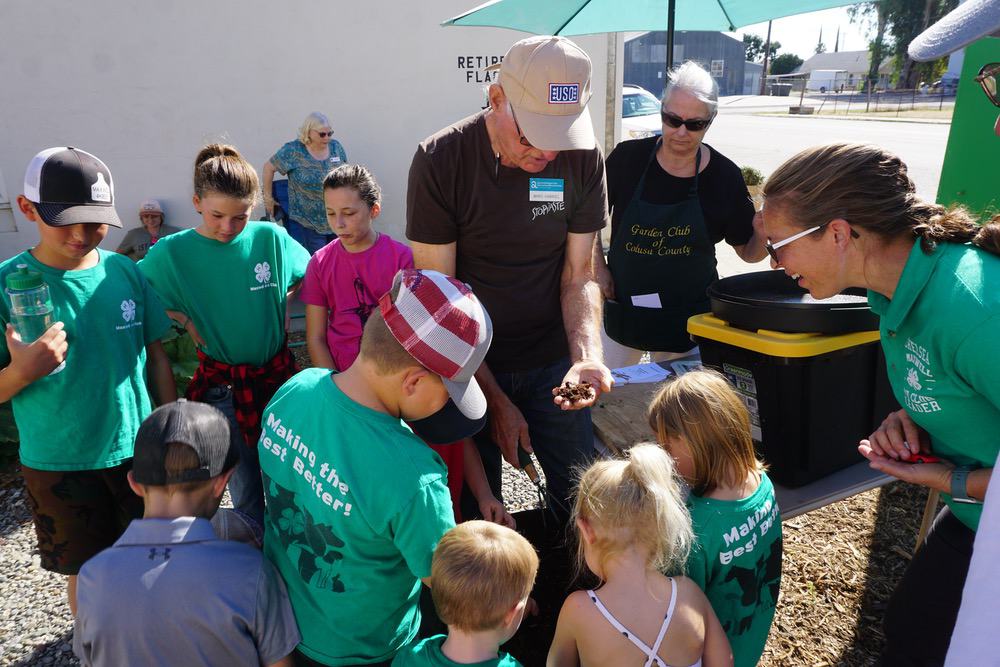
Composting worms have no teeth but they make very short work of a banana peel and other household organic waste, as Maxwell 4-H youth learned at a special presentation on Saturday.
Certified Master Composter Ward Harbriel taught the youth that composting is not only good for the environment, but is a law in California that requires residents and businesses in California to recycle all organic matter, such as food waste, yard waste, paper, and cardboard.
“You can’t just throw garbage away,” Habriel said. “Organic waste in landfills is a leading cause of methane gas, believed to contribute to climate change. Nationally, food waste is either the first or second largest item by volume going into landfills.”
Youth learned that while all organic waste can be composted and used as a soil additive, raising composting worms (not earthworms) can speed up the process and make valuable natural fertilizer for houseplants and gardens.
“If you make it yourself you know exactly what’s in it,” Harbriel said. “It’s also a fun thing to do.”
Compost worms are surface-dwelling invertebrate animals, slightly smaller than earthworms, that can eat through fruit and vegetable trimmings, coffee grounds and paper filters, tea bags, citrus rinds, and rinsed and crushed eggshells.
Harbriel said worm composting in a 10”-16” plastic bin – in a bed of only moist newspaper strips is a great project for 4-H and classrooms.
“Under ideal conditions, worms will eat about half their weight each day,” he said. “They will even eat the newspaper, which no longer has toxic ink. It’s all natural, even the color ink.”
The composting demonstration was held at the Community Garden, between the Maxwell Post Office and American Legion Hall.
The garden is a project of 4-H and the Garden Club of Colusa County, and was funded by a $1,000 grant from National Garden Clubs Inc.
“The work that has been done is so fantastic because Maxwell did not have a community garden,” said Carolyn Froelich, Garden Club secretary. “And we’re not done yet. We will be planting trees this fall.”
The youth and their 4-H leader Chelsea Dirks said they got a kick out of the worms and the idea that composting organic waste as a 4-H or school project is a great way to help the planet, and, at the same time, produce a natural, high quality soil amendment that the group could sell.
“I think we can do this,” Dirks said. “We might be able to start a bin at the elementary school and use organic waste from the cafeteria.”
G.D. Rudiger, 9, said he would also like to try worm composting at home.
“It looks like fun and it’s good for the environment,” Rudiger said. ■