

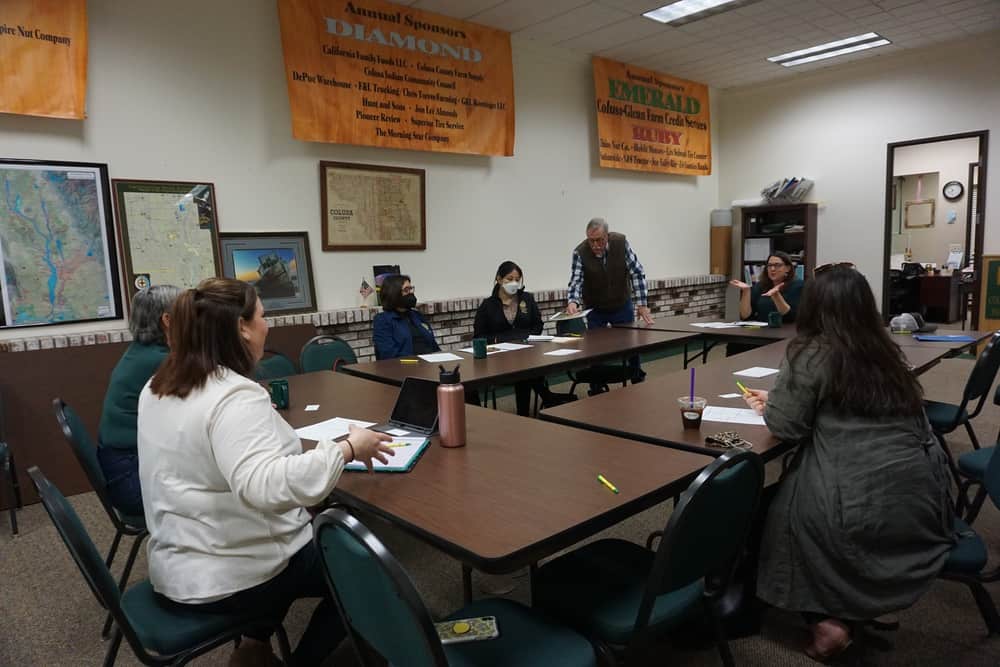
The Williams City Council has agreed to help John Troughton in his effort to get cities to lobby the state government for a greater return on the sales and gas taxes they generate, now that the movement has gained momentum.
Troughton has kept to a vigorous schedule of engagements in recent months, including reaching out to the Chamber of Commerce, Farm Bureau, Rotary Club, California legislators, and government officials.
Troughton said he plans to personally attend the council meetings of about 12 Northern California cities, and hopes to reach many others through written correspondence.
His goal is to develop a coalition of cities who will request the state, through new legislation, to increase the amount of sales tax revenue they share with municipalities and counties by 1 cent on the dollar.
“The Bradley-Burns tax started in 1949 at 3 cents sales tax, all of which went to the state,” Troughton said. “In 1950, 1 cent was added for local jurisdictions. The state has raised the sales tax rate as high as 7.25 cents in 2009, but the cities’ share has stayed at 1 cent.”
Troughton said he would like to see the State increase the amount cities receive from the sales taxes they generate, along with a change in the formula on how gas tax revenue is returned to local jurisdictions for transportation projects (SB 1).
SB 1, the Road Repair and Accountability Act, generates 12 cents per gallon of gas and 20 cents per gallon of diesel sold, but is returned to cities and counties based on population – not the total amounts the cities and counties generate for the state through the taxes.
Additionally, the distribution of the 7.25 percent sales taxes on the purchase of taxable goods (most of which in Williams is generated through the sale of gasoline) is 3.94 percent to the state general fund; 1 percent to local general funds; .25 percent to the County Transportation Fund; 1.56 percent to County Realignment for Mental Health/Public Safety Services; and .50 percent to the Public Safety Augmentation Fund.
“We have increased our contribution in 10 years from $6 million to $8.4 million (per year), which is based on $3.50 a gallon, not $4.50 a gallon like it is now,” said Troughton, who serves as the elected City Treasurer. “We are probably sending the state about $9.5 million a year now.”
Troughton said there are over 212 cities under 30,000 in population, including Williams, and it is his goal they come together to lobby the Legislature to increase the amount cities and counties receive from sales taxes (Bradley-Burns) from 1 cent on the dollar to 2 cents, and for a greater share of the SB 1 taxes.
“Our infrastructure is in need of repair,” Throughton said. “Our cities cannot catch up with this problem.”
The Williams City Council on Jan. 19 agreed to support Throughton’s efforts by contributing to the cost of traveling to cities and for clerical help.
The City Council will also consider adopting a Resolution asking the state for a greater return on taxes, which can be used as a template for other cities.
“Tax measures fail,” Troughton said. “This is not a tax increase. It’s a fair distribution of existing taxes.” ■